 Bravo Fleet







One of the largest meeting rooms aboard the USS Cardinal was deliberately chosen for this moment of negotiation between the Klingons and Romulans.
The celestial bodies of the Theta-Khamor system lay exposed outside the room’s massive windows. Khamor III rotated slowly below, cloud-wrapped and dark with precipitation. Khamor IV hovered farther out, harsh and pitted. Its rocky surface was scored by active drilling sites marked by crimson pinpricks of light that glowed faintly against the shadowy surface. Between them, asteroids of the Khamorian Shards drifted in slow, dangerous arcs. Sunlight fractured and reflected off the ice-flecked rocks. Pale golden light bounced off their surfaces and sent reflections back out through the void.
Captain Raku Mobra sat at the head of the table. The Bajoran’s olive complexion caught the neutral white light of the room cleanly. His silver earring glinted when he turned his head. Mobra had insisted the lighting remain unchanged in strict adherence to Federation standards. Illumination would neither be Klingon red nor overwhelmingly bright in the Romulan way.
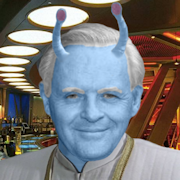
Commander Smythe sat to the captain’s right, posture relaxed in a deliberate way. Counselor Ikastrul Zaa took position alongside them. Her gentle ebony eyes moved constantly as she read the emotional undercurrents that rippled through the room. Lieutenant Commander M’kath sat rigid near the far end of the table, arms folded and shoulders squared. Lieutenant Raii leaned back casually against his seat. The Orion legal advisor’s viridescnt complexion seemed to reflect every golden ray of the spectrum through copper undertones especially prominent in his cheeks. The expression behind his neon pink irises appeared unreadable.
Across from them sat the delegations.
Yo’HoD K’Vel of the House Ma’Tok sat solidly, hands braced against the table’s edge. The graying curls along the sides of his ruddy-brown hair were as prominent as ever. Beside him, la’ Melvar of the House K’Chungh leaned against a nearby wall. His dark eyes studied his surroundings with a restless glare.
The Romulan delegation mirrored them in number and posture. Colonel Joliuhk’s tall frame towered over the back of his seat. His rounded frame was not to dissimilar to K’Vel’s portly build. His hands were folded calmly above his metallic belt buckle. Sub-commander Nirrot sat next to him. She sat with her chin lifted, gaze cold and precise.
No one spoke at first.
The silence stretched, heavy but intentional.
Mobra broke it.
“We have heard the concerns from both sides,” the captain said evenly. “Both claims intersect along either side of the Khamorian Shards. The Klingons speak of survival and autonomy. The Romulans speak of refuge and distance from old wars.”
Melvar snorted quietly.
Raku continued without looking at him. “Both claims stem from loss.
K’Vel inclined his head slightly. “We do not deny it.”
Joliuhk folded his hands more tightly. “Nor do we.”
Raku stepped forward one pace. “The difference lies not in need, but in method.”
Melvar leaned in. “We drill because digging deep into a planet’s surface to gather necessities is our way.”
“And because it is familiar,” Commander Marlon Smythe said calmly. “Not because the methods are optimal. The Akaru believe they can show you more productive ways.”
Melvar’s gaze snapped to him. “Now Starfleet sees fit to tell Klingons how to mine now, I gather.”
“I can’t hold back when I see an attempt that might fail,” Marlon replied. “I’ve watched enough plans based on old ways collapse. Especially if new, more effective methods come into the picture.”
M’kath shifted his weight as his right foot stepped forward. “Aggressive extraction in sensitive areas can only invite resistance,” the chief tactical officer said. His voice carried weight even now as he spoke in restrained volume. “Not only from enemies. But from space itself. These spatial anomalies may be a sign that discretion is needed.”
Melvar turned toward him, frustration written across his ridged facial features. “You repeat Starfleet fears now?”
“I repeat Klingon history,” M’kath replied. “Our people have lost more worlds to arrogance than to war.”
A murmur rippled along the Klingon delegation behind K’Vel. The gathered Romulans exchanged quiet stares.
Nirrot seized the moment. “And yet you drill across the Shards from our skies,” she said coolly. “Your ships cast shadows over a peaceful Romulan settlement that was meant to escape your overbearing presence.”
K’Vel’s jaw tightened. “We did not follow you out of spite.”
“Intent matters less than impact,” Nirrot replied.
Ikastrul leaned forward slightly. “Fear sharpens perception,” she said gently. “This can happen on both sides of a dispute.”
Melvar scoffed. “Betazoid insight does not change ore yields.”
“No,” Zaa agreed. “But the insight could explain the reasons for escalation on both sides.”
Raii straightened. “Which is why we’re all gathered here,” the JAG officer said confidently. “Not to argue claims into the ground, but to keep this system intact long enough for all of you to use it.”
Melvar gestured sharply toward the windows. “The Shards remain stable.”
“For now,” Raii replied. “Akaru data suggests there are problems bigger than the Shards getting a little shaky. The presence of spatial eddies and assorted disturbances have increased across several nearby systems. The Akaru have sonic records that tie these increases to your first days of resource collection on Khamor IV.”
At the mention of the Akaru, tension shifted again.
Joliuhk nodded. “Their concerns are not symbolic. Their harmonic surveys also show growing disturbances beneath Khamor IV’s crust.”
“Prophecies,” Melvar said dismissively.
“Measurements as well,” Smythe corrected. “These are repeated, correlated reports that have been verified by the Cardinal’s sensors.”
K’Vel studied the rocky planet his people claimed through the windows. “We acknowledge the presence of these anomalies.”
“You still dismiss their cause,” Nirrot said. “As you dismiss our suggestions.”
Melvar turned toward her fully. “You accuse us while hiding behind Federation mediation.”
Nirrot smiled thinly. “I accuse you because you listen only when the voice of others can speak for us.”
“Enough,” M’kath said. “This is not a battlefield.”
Melvar’s eyes flashed. “Then tell this one to stop posturing like combat is imminent.” He looked down to the diminutive Nirrot.
Raii spoke next, voice smooth. “We all posture for survival when we feel threatened.”
K’Vel looked from Nirrot to Melvar, then to Captain Raku. “You ask us to slow extraction that we desperately need.”
“We simply ask you to consider alternative ways to extract,” Raku replied. “Consider shared access with Akaru scientists. They want to shift towards phased harvesting that features techniques that don’t tear the crust open.”
“And if those techniques fail?” Melvar demanded.
“Then we reassess,” Smythe said. “Together as one team.”
Nirrot folded her arms. “But the Klingons will still drill while we wait.”
“For now,” Raku said. “Yes.”
Joliuhk exhaled slowly. “We agree to share resources as well,” he said. “We are prepared to barter and compromise.”
Melvar nodded sharply. “We will not completely abandon our mining operations.”
“No one has asked you to,” Captain Raku said. “We’re just asking you to learn a few safer methods.”
K’Vel’s gaze lingered on Khamor IV again. “The Akaru believe dangerous relics sleep beneath its surface.”
“They believe your disturbances can only awaken more danger,” Ikastrul added.
Melvar shook his head. “They spit fear wrapped within poetry.”
“Perhaps it is more like wisdom preserved from ancient memories,” Joliuhk countered.
Silence returned, broken only by the hum of the Cardinal’s systems.
Outside, sunlight shifted as one of the system’s distant suns edged into alignment. Scattered light bounced off the Shards and threw fractured reflections through the windows. The effect painted the room in drifting bands of gold and shadow.
Smythe used the still moment. “This system is already starting to destabilize,” he said. “Subspace eddies increase every day. Navigation errors will increase for you if this keeps up. If mining accelerates unchecked, none of you will hold this territory for long. Not Klingons. Not Romulans.”
Raii nodded. “And Starfleet does not plan to arbitrate evacuations. You all could be on your own in an emergency.”
Melvar’s jaw clenched. “You threaten us with chaos.”
“No,” Captain Raku said softly. “We warn you of it.”
K’Vel straightened. “We will not surrender our right to survive.”
“And we will not surrender our chance to rebuild,” Joliuhk replied.
Melvar scoffed again. “We do not kneel to scholars, nor to those who are down on their luck.”
Raku met his gaze directly. “You do not need to kneel. It only makes sense to adapt to your surroundings. That’s nature’s way. Space is no different than the forest.”
The words landed harder than a shout.
K’Vel exhaled slowly. “The Akaru wish to demonstrate alternative methods to our tried and true ways. How are we to learn their methods?”
“Correct,” Marlon said. “They offered to instruct both delegations in their latest, less-invasive methods.”
Nirrot hesitated. “On neutral ground.”
“On both planets,” Ikastrul replied.
Melvar opened his mouth, then stopped.
K’Vel spoke first. “We will observe and participate.”
Melvar turned sharply. “Yo’HoD!”
K’Vel raised a hand. “We observe,” he repeated. “Yet we do not cease drilling yet.”
Raku inclined his head. “That is acceptable.”
Joliuhk nodded. “We will also attend.”
Nirrot’s eyes narrowed, then softened slightly. “We will indeed listen.”
Raii smiled faintly. “This is progress.”
Beyond the windows, Khamor IV rotated slowly, scarred but intact. The Shards drifted aimlessly. For the first time since the Cardinal arrived, no one spoke of war.